
📋 Table of Contents
- 1. Why "Safe" Tap Water Isn't the Same as "Contaminant-Free"
- 2. Four Categories of Contaminants Found in GTA Tap Water
- 3. How Reverse Osmosis Works — and Why It's Effective
- 4. Coway's Three-Stage NEO SENSE RO Membrane: What Each Stage Does
- 5. What a Water Purifier Cannot Do
- 6. Frequently Asked Questions
Why "Safe" Tap Water Isn't the Same as "Contaminant-Free"
Toronto's tap water is treated and regulated. It consistently meets provincial and federal drinking water standards. And for most people, most of the time, it is safe to drink. That said, "meeting regulatory standards" and "being free of all contaminants" are two different statements — and it's worth understanding the difference.
Municipal water treatment is designed to disinfect water against biological hazards and remove a defined list of regulated contaminants. What it is not designed to do is remove every trace of every substance that may be present in source water. Microplastics, for example, were only added to the EPA's drinking water watch list for the first time in 2026. PFAS — per- and polyfluoroalkyl substances — remain largely unregulated at the municipal level in Ontario. And heavy metals can be introduced into drinking water not at the treatment plant, but through old lead-containing pipes inside the home, after water has already been treated.
💡 The Key Distinction
Municipal water treatment targets biological safety and regulated chemical limits. A point-of-use water purifier installed at your kitchen tap — like a Coway RO system — provides an additional stage of filtration that addresses contaminants the city's treatment system is not specifically designed to remove, including microplastics, PFOS/PFOA, and residual heavy metals that may enter water between the treatment plant and your faucet.
Four Categories of Contaminants Found in GTA Tap Water
1. Heavy Metals — Including Lead from Older Pipes
Toronto's water treatment process does not introduce heavy metals into the water — but the city's older infrastructure can. Pre-1950s homes in neighbourhoods across the GTA may still have lead service lines or lead solder in internal plumbing. The City of Toronto's own data acknowledges this risk and maintains an active lead mitigation strategy. Water that is clean when it leaves the treatment plant can pick up lead, copper, and other metals as it travels through aging pipes to your tap.
The risk is greatest in homes built before 1955, in buildings where pipes have not been replaced, and during periods when water has been sitting stagnant in old pipes — such as first thing in the morning.
2. PFOS and PFOA — "Forever Chemicals"
PFAS (per- and polyfluoroalkyl substances) — including PFOS (perfluorooctane sulfonate) and PFOA (perfluorooctanoic acid) — are a class of synthetic chemicals used for decades in products ranging from non-stick cookware to firefighting foam. They are called "forever chemicals" because they do not break down naturally in the environment or in the human body.
In August 2024, Health Canada published an interim drinking water objective of 30 nanograms per litre (ng/L) for the sum of 25 PFAS — but this is an objective, not an enforceable regulation, and Ontario municipalities are not yet required to test for PFAS. Toronto's own testing in 2023 showed only a handful of detectable PFAS results across approximately 300 samples, with levels generally well below the new objective. However, experts note that PFAS monitoring across Canada remains inconsistent, and ongoing exposure through water is a well-documented concern nationally.
3. Microplastics
Microplastics — plastic particles smaller than 5 mm — have been detected in municipal drinking water systems worldwide. In Ontario tap water, studies have identified approximately 20 microplastic particles per litre on average. Conventional municipal water treatment processes are not specifically optimized to remove microplastics, particularly the smaller particles, and some research has found that they pass through treatment plants at measurable rates.
The health effects of ingesting microplastics through drinking water are not yet fully understood. The EPA added microplastics to its drinking water watch list in 2026, signalling growing regulatory attention to the issue. In Canada, the concern is similarly increasing, though formal guidelines are still being developed.
4. Chlorine and Disinfection Byproducts
Chlorine is added to Toronto's water supply as a disinfectant — an essential step in making water biologically safe. Most of the chlorine dissipates before reaching your tap, but residual chlorine remains, along with disinfection byproducts (DBPs) that form when chlorine reacts with naturally occurring organic matter in source water. These byproducts are regulated, but their presence contributes to the aftertaste and odour that many Toronto residents associate with tap water.
⚠️ Ontario's PFAS Monitoring Gap
Unlike the United States, where the EPA has established enforceable maximum contaminant levels (MCLs) of 4 ng/L for PFOA and PFOS individually, Ontario municipalities are currently not required to test for PFAS in drinking water. Health Canada's 2024 objective is an advisory target, not a regulated limit. A point-of-use RO system provides a household-level layer of filtration regardless of what municipal monitoring does or doesn't cover.
How Reverse Osmosis Works — and Why It's Effective
Reverse osmosis (RO) is a water purification process that forces water through a semi-permeable membrane under pressure. The membrane's pore size is approximately 0.0001 microns — small enough to block dissolved salts, heavy metal ions, viruses, bacteria, PFAS molecules, and microplastic particles, while allowing water molecules to pass through.
To put the membrane's precision in context: a human hair is approximately 70 microns in diameter. The RO membrane's pores are roughly 700,000 times smaller than a human hair. This is why RO is widely considered one of the most effective point-of-use water purification technologies available for residential use — it operates at a molecular level, not just a particle level.
RO systems are certified under NSF/ANSI Standard 58, which is the relevant standard for PFAS removal performance recognized by Health Canada. Activated carbon filtration (typically used as a pre- or post-filter in RO systems) is certified under NSF/ANSI Standard 53. A well-designed multi-stage RO system addresses a broader range of contaminants than any single filtration method alone.
💡 RO vs. Standard Carbon Filters
Standard pitcher or tap-mounted carbon filters are effective at reducing chlorine, certain odours, and some heavy metals — but they are not designed to remove PFAS, viruses, or microplastics, particularly the smaller particles. Carbon filters have a pore size of roughly 0.5 to 10 microns — large enough for many contaminants to pass through. RO membranes at 0.0001 microns operate at a fundamentally different scale.
Coway's Three-Stage NEO SENSE RO Membrane: What Each Stage Does
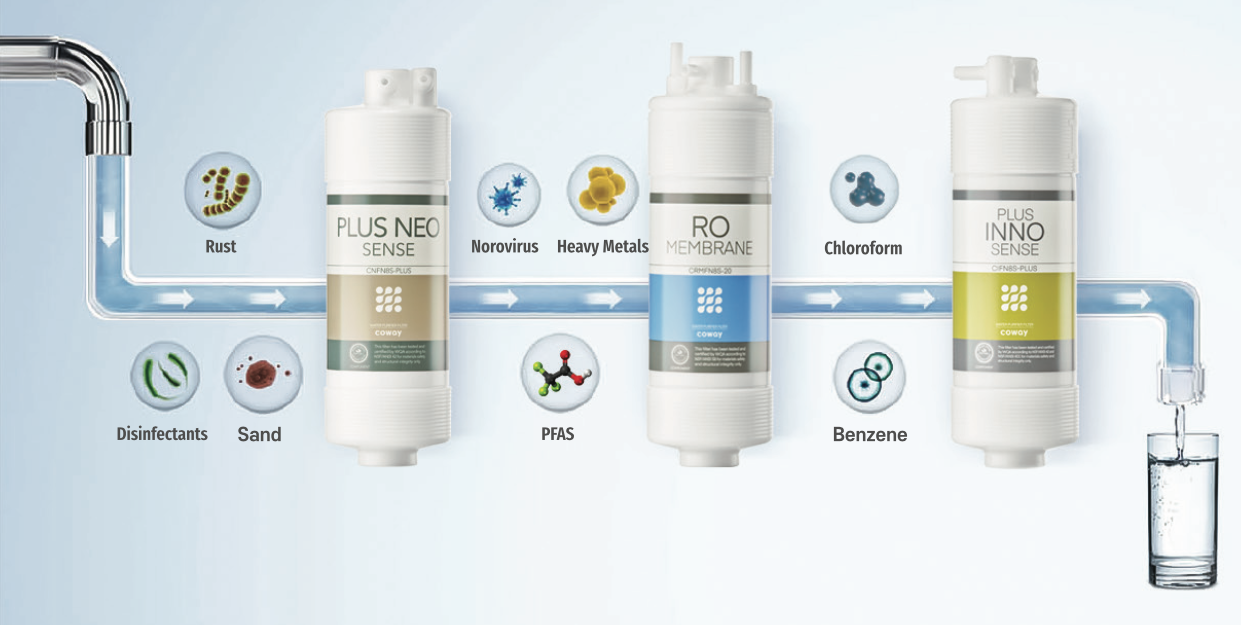
The Coway NEO SENSE water purifier uses a three-stage filtration system built around an RO membrane. Each stage targets a different category of contaminants — working in sequence so that each layer of filtration is most effective, and the RO membrane is protected from premature clogging by the pre-treatment stages that precede it.
Stage 1: Sediment Pre-Filter
The first stage captures larger suspended particles — sediment, rust, sand, and visible particulates — before water reaches the carbon or RO stages. This pre-filter protects the downstream membranes from physical damage and premature clogging, extending their effective lifespan.
In Toronto homes, this stage is particularly relevant for properties with older iron pipes, where rust particles and sediment can be present at the tap. It also captures larger microplastic particles before water reaches the finer RO membrane.
Stage 2: Activated Carbon Block Filter
The carbon block stage targets chlorine, chloramines, chlorine-related disinfection byproducts, and volatile organic compounds (VOCs). Carbon filtration works through adsorption — contaminants chemically bond to the large surface area of the activated carbon material and are removed from the water stream.
This stage is also effective at reducing certain heavy metals, particularly lead and copper, which may be present in water that has passed through older residential plumbing. Removing chlorine at this stage also protects the RO membrane — chlorine can degrade RO membrane materials over time if it is not removed upstream.
Stage 3: NEO SENSE RO Membrane
The RO membrane is the core of the system. At a pore size of 0.0001 microns, it removes contaminants that the upstream stages cannot address — including dissolved heavy metal ions, PFOS and PFOA molecules, viruses, and microplastics. The "NEO SENSE" designation refers to Coway's proprietary membrane formulation, which is engineered for high contaminant rejection rates while maintaining stable water flow.
Contaminants that are blocked by the membrane are flushed out through a waste water stream rather than accumulating in the filter, which is one of the characteristics that distinguishes RO filtration from adsorption-based methods where contaminants remain in the filter material and can leach back if the filter becomes saturated.
💡 What "Three-Stage" Means in Practice
Each stage handles what the others cannot. The sediment filter protects the carbon block. The carbon block removes chlorine, protecting the RO membrane, and handles heavy metals and organics that carbon is well-suited for. The RO membrane handles the dissolved contaminants — heavy metal ions, PFAS molecules, viruses — that are too small for sediment filtration and not fully addressed by carbon alone. The three stages work in sequence, not independently.
Summary: What the NEO SENSE System Removes
- ✅ Heavy metals — including lead, copper, mercury (from old pipes and source water)
- ✅ PFOS and PFOA — "forever chemicals" removed at the RO membrane stage
- ✅ Microplastics — captured at both the sediment and RO membrane stages
- ✅ Viruses and bacteria — removed by the RO membrane (pore size is smaller than most waterborne pathogens)
- ✅ Chlorine and disinfection byproducts — removed at the carbon block stage
- ✅ Sediment, rust, sand — captured at the first-stage pre-filter
- ✅ Dissolved salts and minerals causing hardness — including the calcium and magnesium responsible for Toronto's 121 mg/L hard water
What a Water Purifier Cannot Do
Accuracy matters when talking about water filtration. A Coway RO water purifier treats the water that flows through it at your kitchen tap. It does not treat water anywhere else in the home — not shower water, not laundry water, not water used by appliances connected to other taps. It is a point-of-use system for drinking and cooking water.
Additionally, no home water purifier should be described as a substitute for safe municipal water infrastructure. In situations where there is an active boil-water advisory, follow the advisory. The Coway system is designed for use with municipally treated water as the source — it provides an additional layer of filtration on top of existing treatment, not a replacement for it.
The system also produces a small amount of waste water as part of the RO process — this is a characteristic of RO technology in general, and is the mechanism by which rejected contaminants are flushed away rather than remaining in the filter.
Want the Cleanest Possible Water for Your Toronto Home?
Coway's NEO SENSE water purifier uses three-stage RO membrane technology to remove heavy metals, PFOS/PFOA, microplastics, viruses, and chlorine — delivering cleaner, better-tasting drinking and cooking water straight from your kitchen tap.
Compare Water Purifiers for Toronto Homes →Free consultation • Professional installation • 📞 +1 416-873-4984 • 한국어 상담 가능
Frequently Asked Questions
Yes — PFOS and PFOA are removed at the RO membrane stage. RO filtration is certified under NSF/ANSI Standard 58, which Health Canada identifies as one of the two standards for PFAS reduction in drinking water (the other being NSF/ANSI Standard 53 for activated carbon). The RO membrane's pore size of 0.0001 microns is small enough to block PFAS molecules, which are larger than water molecules but smaller than what sediment or carbon filters alone can reliably capture.
Yes. Studies consistently show RO membrane filtration achieves greater than 99% removal of microplastics, including very small particles. Microplastics range from 100 nanometres to 5 millimetres in size. The RO membrane at 0.0001 microns (0.1 nanometres) is small enough to block particles far smaller than even the smallest microplastics. Larger microplastics are also captured by the sediment pre-filter in the first stage, before water reaches the RO membrane.
Standard pitcher filters (like Brita) use activated carbon, which is effective at reducing chlorine taste and some heavy metals — but they are not designed to remove PFAS, viruses, or microplastics. Carbon filter pore sizes are typically 0.5–10 microns, which allows PFAS molecules and many microplastic particles to pass through. A three-stage RO system addresses all of those contaminants in sequence: sediment removal, carbon filtration, and then RO membrane rejection at 0.0001 microns. The filtration performance is substantially different, not just incrementally better.
Filter replacement intervals depend on usage and source water quality. As a general guideline for Toronto households: the sediment pre-filter and carbon block filter typically require replacement every 6–12 months, while the RO membrane itself generally lasts 2–3 years under normal residential use. A Coway system includes filter life indicators so you know when replacement is due — running a filter past its effective life reduces filtration performance and can allow contaminants to pass through that would otherwise be removed.
Yes. The RO membrane removes the dissolved calcium and magnesium minerals that cause Toronto's tap water hardness (averaging 121 mg/L). Purified water from the Coway system is substantially softer, which means no more limescale buildup in your kettle or coffee maker, and noticeably cleaner-tasting drinking water and cooking water. The sediment pre-filter and carbon stage upstream also protect the RO membrane from the wear that would otherwise occur from consistent exposure to hard water minerals at higher flow rates.