
📋 Table of Contents
- 1. The Question Every New Toronto Parent Asks
- 2. Toronto Tap Water: Safe by Standard, But Is It Safe Enough for Your Baby?
- 3. What About Bottled Water or a Brita Filter?
- 4. Why a Coway RO Water Purifier Is the Ideal Formula Water Solution
- 5. Protecting Both Your Baby and Your Well-Being
- 6. Frequently Asked Questions
The Question Every New Toronto Parent Asks
When you bring a new baby home in Toronto, the question comes up almost immediately — and often at 2 in the morning, while you're standing at the kitchen tap, exhausted and unsure: Is this water actually safe to make formula with?
For parents who grew up in countries where point-of-use water purifiers are standard — South Korea, Japan, China — the answer back home was simple: you used the purifier. In Canada, many new parents find the answer less clear. Toronto's tap water is officially described as safe. But "officially safe" and "the best possible choice for a newborn's daily nutrition" are not necessarily the same thing.
💡 What This Guide Covers
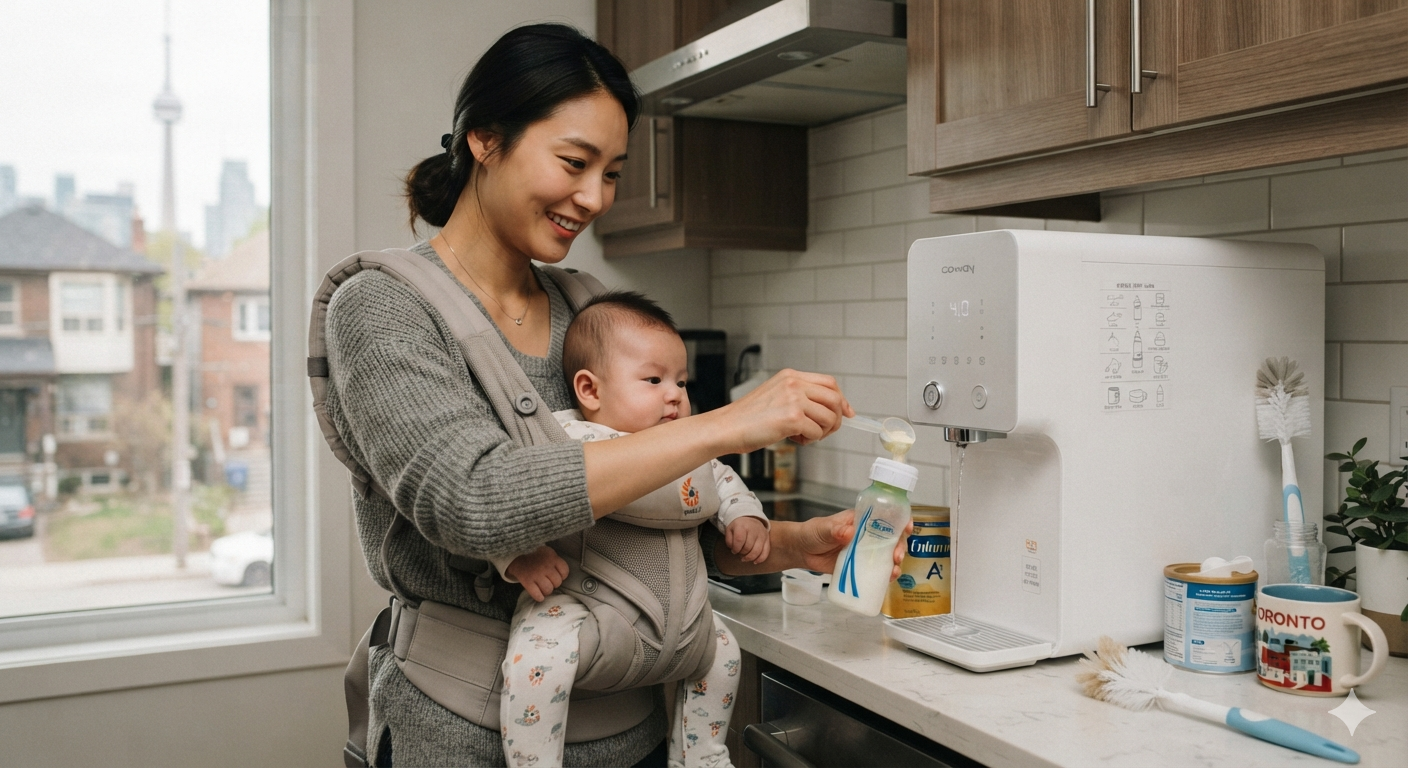
This guide is for new parents in Toronto and the GTA who are making formula with tap water, bottled water, or a basic filter — and want to understand whether they're making the safest possible choice for their baby. We'll walk through what Toronto's tap water actually contains, why boiling alone isn't enough, what the alternatives do and don't solve, and how a Coway RO water purifier addresses all of it — including making 3 AM formula preparation significantly faster.
Toronto Tap Water: Safe by Standard, But Is It Safe Enough for Your Baby?
Toronto's water treatment plants produce water that meets Ontario provincial and Canadian federal drinking water standards. At the point where it leaves the treatment facility, the water is well-treated and clean. That's the honest starting point.
The problem — and it's a well-documented one — is what happens between the treatment plant and your kitchen faucet.
Old Pipes Are the Real Issue
Toronto is a city with an enormous stock of older housing. Neighbourhoods across downtown, North York, Scarborough, and Etobicoke are full of homes and condos built in the 1950s, 60s, and 70s. Many of these buildings have aging internal plumbing — and homes built before 1955 may still have lead service lines or lead solder in their plumbing systems.
The City of Toronto officially acknowledges this issue and runs an active lead pipe replacement program. But millions of older homes and rental condos still have aging infrastructure. Clean water that leaves the treatment plant can pick up lead, copper, and other metals as it travels through old pipes to your tap — particularly water that has been sitting in pipes overnight, which is the water you use first thing in the morning.
⚠️ Boiling Doesn't Remove What Matters Most for Babies
Boiling water kills bacteria and viruses — and it's better than not boiling if you're using tap water directly. But boiling does not remove lead, heavy metals, microplastics, or residual chlorine. In fact, as water boils and some of it evaporates, the remaining water becomes slightly more concentrated in dissolved minerals and contaminants — including any lead that was present. For a newborn drinking formula multiple times a day, this matters.
💡 How to Check Your Home's Plumbing Risk
If you're unsure whether your home has lead pipes, you can check the City of Toronto's lead pipe inventory map at toronto.ca, or ask your landlord or condo property management. If you're renting — which many young families in Toronto are — you likely can't replace the plumbing yourself. That's precisely why a point-of-use water purifier at the kitchen tap is the most practical solution.
What About Bottled Water or a Brita Filter?
Bottled Water — A Heavy, Imperfect Solution
Many new Toronto parents default to buying bottled water for formula, especially in the early weeks. It's an understandable choice. But it comes with real limitations that add up quickly.
Carrying heavy water cases from Costco or the grocery store is genuinely difficult — and for a postpartum mother whose body is still recovering, lifting and carrying large water bottles repeatedly is a physical burden that shouldn't be underestimated. Toronto's winters make grocery trips harder still, and if you don't own a car, the logistics become a real daily challenge.
Beyond the physical inconvenience, bottled water carries its own safety concern: microplastics. Research consistently shows that plastic bottles leach microplastic particles into the water they contain — particularly when bottles are stored in warm conditions (like a car trunk in summer, or a sunny apartment). For water you're using to make your infant's formula every day, this is worth factoring in.
💡 The Nighttime Formula Problem with Bottled Water
Even if bottled water were perfect, it doesn't solve the 3 AM formula problem. You still need to boil it, wait for it to reach 70°C, mix the formula, then cool it to feeding temperature. With a Coway hot-and-cold purifier, that entire process collapses to under two minutes — which, during a night feeding with a crying baby, is a meaningful difference.
Pitcher Filters Like Brita — Not Sufficient for Infant Formula
Brita and similar activated carbon pitcher filters are effective at one thing: reducing chlorine taste and odour. For adults who simply want better-tasting drinking water, they're a reasonable low-cost solution. For infant formula water, they have three significant limitations.
- Lead removal is incomplete: Carbon pitcher filters reduce some heavy metals, but they are not certified to reliably remove lead at the level required for infant safety. The filter pore size (0.5–10 microns) is orders of magnitude larger than what's needed to block dissolved lead ions.
- Microplastics pass through: At 0.5–10 micron pore sizes, Brita-style filters allow most microplastic particles to pass straight through.
- A missed filter change becomes a health risk: When an activated carbon filter becomes saturated — which happens faster than the replacement schedule when used heavily — it can begin releasing the contaminants it has absorbed back into the water. For exhausted new parents who are managing a newborn's feeding schedule, sleep deprivation, and everything else, tracking a filter replacement schedule is one thing too many. A saturated filter used for infant formula is not a minor inconvenience.
⚠️ If You've Ever Missed a Filter Change
Carbon filters that have exceeded their effective life don't just stop working — they can actively re-release previously captured contaminants into the water. For adults, this is undesirable. For infants whose immune and neurological systems are still developing, consistent exposure to even small amounts of lead or other metals through daily formula is a genuine concern. The safest system for baby formula water is one where filter maintenance is handled by a professional on a fixed schedule — not by a sleep-deprived parent tracking it themselves.
Why a Coway RO Water Purifier Is the Ideal Formula Water Solution
There are two reasons Coway's water purifier stands out specifically for Toronto families with infants. The first is what it removes from the water. The second is how much easier it makes formula preparation.
Reason 1: The Cleanest Possible Water — Three-Stage NEO SENSE RO Filtration
The Coway NEO SENSE system uses a three-stage filtration process built around a Reverse Osmosis (RO) membrane. RO is the gold standard for residential water purification: its membrane pore size of 0.0001 microns — roughly 700,000 times smaller than a human hair — is small enough to block dissolved heavy metal ions, PFAS molecules, microplastics, viruses, and bacteria, while allowing water molecules to pass through.
Here's what the three-stage system removes:
- ✅ Lead and heavy metals — dissolved from old pipes, blocked at the RO membrane stage at the molecular level
- ✅ Microplastics — captured by both the sediment pre-filter and the RO membrane
- ✅ Residual chlorine and disinfection byproducts — removed by the activated carbon block stage
- ✅ Viruses and bacteria — the RO membrane pore size is smaller than most waterborne pathogens
- ✅ PFAS (forever chemicals) — removed at the RO membrane stage
- ✅ Hard water minerals — calcium and magnesium causing Toronto's 121 mg/L hardness are removed, producing soft water ideal for formula
That last point is worth highlighting. The World Health Organization (WHO) recommends using soft water for preparing infant formula. This is because harder water — which contains higher concentrations of dissolved minerals — can alter the nutritional balance of reconstituted formula. RO-purified water, being very soft, is as close to ideal formula water as you can get from a home tap. All the vitamins and minerals your baby needs are already in the formula powder itself — what matters for the water is that it contains nothing harmful.
Reason 2: The 3 AM Game-Changer — Instant Hot Water, No Boiling Required
If you've prepared formula by boiling and cooling water at night, you know what it feels like: you heat the water, you wait for it to stop rolling, you set a timer or guess when it's reached 70°C, you add the powder, and then you wait again for it to cool to feeding temperature while your baby cries. On a good night, this takes 15–20 minutes. On a bad night, it takes longer.
💡 How to Make Formula with a Coway Hot-and-Cold Purifier
Coway's hot-and-cold water purifier dispenses water at approximately 85–90°C (hot) and room temperature (purified). By mixing these in the right ratio for your formula serving size, you can achieve 70°C — the WHO-recommended temperature for formula preparation — instantly. No boiling. No cooling wait. The correct temperature water is ready in under a minute. For a baby feeding schedule that runs around the clock, this change in your nighttime routine is genuinely significant.
The ratio of hot to room-temperature water will vary slightly depending on your formula brand's instructions and the serving size — but most parents find their rhythm within the first few days. Once you've done it, going back to boiling and waiting feels unthinkable.
Protecting Both Your Baby and Your Well-Being
Let's summarise your options as a new Toronto parent choosing water for infant formula:
- 🚫 Boiled tap water: Removes bacteria, but not lead, microplastics, or chlorine. Slow and tiring at every feed.
- 🚫 Bottled water: Avoids lead pipes but introduces microplastic risk and the daily burden of carrying heavy cases. Still requires boiling and cooling for formula.
- 🚫 Brita-style filter: Reduces chlorine taste, but doesn't fully remove lead or microplastics. Missed filter changes are a real risk with a newborn in the house.
- ✅ Coway RO water purifier: Removes lead, microplastics, chlorine, viruses, and PFAS. Hot water dispenser eliminates the boiling and cooling step entirely. Filter maintenance handled by a professional on schedule — not by you.
That last detail — professional maintenance — is one that Toronto parents consistently say matters more than they expected. Coway's service includes regular visits from a trained Cody (service technician) who performs internal sanitization and replaces filters on a set schedule. You don't track it. You don't buy replacement filters. You don't worry about whether the filter has been changed recently.
For a system that's making the water your baby drinks multiple times every day, professional hygiene management isn't a luxury — it's the right way to run it.
💡 What Toronto Parents Say
"We set up the Coway purifier when our daughter was three weeks old. The difference in our nighttime routine was immediate — hot and cold water mixed, formula ready in two minutes. And knowing the water has gone through RO filtration means we're not worrying about whatever's in our building's pipes." — GTA parent, North York
Give Your Baby the Cleanest Water Possible — Every Single Feed
Coway's RO water purifier removes lead, microplastics, chlorine, and PFAS from your Toronto tap water — and the hot-and-cold dispenser makes nighttime formula preparation faster than you thought possible. Korean-language consultation available across the GTA.
Book a Free Coway Water Purifier Consultation →Free home consultation • Professional Cody maintenance • 📞 +1 416-873-4984 • 한국어 상담 가능
Frequently Asked Questions
Boiling kills bacteria and viruses — and is better than using unboiled tap water directly. But boiling does not remove lead, heavy metals, microplastics, or residual chlorine. In fact, as water boils and evaporates, the dissolved minerals and any contaminants present become slightly more concentrated. For infants drinking formula multiple times daily, the cumulative effect of lead or microplastics in every feed is a real concern. An RO water purifier addresses all of these at once.
Bottled water avoids the lead pipe problem specific to older Toronto homes, which is a genuine advantage. However, plastic bottles can leach microplastics into the water — particularly when stored in warm conditions. Bottled water also requires boiling and cooling before formula use, which doesn't solve the nighttime preparation burden. A home RO purifier provides water that is cleaner than bottled water in most respects, available instantly at the right temperature, without the weight and logistics of carrying cases of bottles.
Yes. A Coway hot-and-cold water purifier dispenses water at approximately 85–90°C (hot setting) and room temperature (purified setting). Mixing these in the right ratio for your formula serving size produces water at approximately 70°C — the temperature the WHO recommends for formula preparation, as it is hot enough to eliminate potential pathogens in the formula powder. No boiling or cooling wait is required. Most parents find they can prepare a full formula bottle in under two minutes once they're comfortable with the mixing ratio.
RO filtration does remove most dissolved minerals — that's accurate. However, infant formula powder is specifically formulated to contain all the vitamins, minerals, and nutrients a baby needs when mixed with water. The water is simply the carrier. The WHO recommends soft water for formula preparation precisely because hard water can skew the mineral balance of reconstituted formula. RO-purified water, being very soft and free of contaminants, is widely considered the ideal choice for formula water. The nutritional needs are in the formula, not in the water.
No — this is one of the most valued aspects of the Coway rental model for new parents. Coway's service includes regular scheduled visits from a trained Cody (service technician) who performs internal sanitization and replaces filters on a set schedule. You don't need to track replacement dates, buy filters yourself, or worry about whether the filter has been changed recently. For a water purifier being used to make an infant's daily formula, having professional hygiene management on a fixed schedule is genuinely important — and it removes one more thing from the mental load of new parenthood.