
📋 Table of Contents
Why Toronto Tap Water Tastes Different
If you've lived in Toronto for a while, you've probably noticed that the tap water has a distinct taste — sometimes described as faintly chlorinated, flat, or slightly chalky. You're not imagining it.
Toronto's tap water is safe to drink. It consistently passes federal and provincial standards. But "safe" and "good-tasting" are not the same thing. Two specific factors affect how Toronto tap water tastes and performs in your kitchen: its mineral hardness and its chlorine treatment.
💡 Quick Takeaway
Toronto's tap water hardness averages 121 mg/L (as CaCO₃) — above Health Canada's recommended comfort range of 80–100 mg/L. Combined with the chlorine used to treat the city's water supply, this is what affects the taste of your drinking water, changes how your food and coffee taste, and causes the white scale buildup inside your kettle.
Toronto's Hard Water: The Real Numbers
According to the City of Toronto's 2024 Drinking Water Analysis Summary, Toronto tap water hardness ranges from a minimum of 116 mg/L to a maximum of 131 mg/L, with an average of 121 mg/L as CaCO₃. This places Toronto in the "moderately hard" category.
Health Canada recommends a hardness level of 80–100 mg/L as the ideal balance. Toronto consistently exceeds that range — and several surrounding GTA municipalities have even higher readings.
How Toronto Compares to Other Cities
Toronto's hardness may appear moderate compared to Kitchener (250–300 mg/L) or Waterloo (300+ mg/L), but it is significantly higher than cities like Vancouver, which often reports single-digit hardness levels. Mississauga, which also draws from Lake Ontario, runs 130–150 mg/L. Richmond Hill and Vaughan can vary between 120–160 mg/L. Across the GTA, hard water is the norm.
🔬 Where Does the Hardness Come From?
Toronto draws its water from Lake Ontario. As the source water moves over Ontario's limestone-rich bedrock (part of the Canadian Shield), it dissolves calcium (Ca) and magnesium (Mg) naturally. These minerals are safe to consume but cause the flat, chalky taste many Toronto residents notice — and they're the reason white scale forms inside kettles and coffee makers.
How Hard Water Affects Your Drinking Water & Cooking
The Taste Problem
The two most common taste complaints about Toronto tap water are a faint chlorine smell or aftertaste, and a flat or slightly mineral character. Both have straightforward explanations.
Chlorine is added at Toronto's water treatment plants as a disinfectant — it's what makes the water safe at the point of treatment. By the time it reaches your tap, most of the chlorine has dissipated, but enough often remains to affect taste, especially in older buildings where water spends more time in the pipes.
Calcium and magnesium at 121 mg/L give water a mildly flat, mineral quality that differs noticeably from the lighter taste of purified or soft water. Many people who have lived in cities with naturally soft water find this difference easy to detect.
How It Affects Cooking
Water is the base ingredient in everything from pasta to rice to soup. Mineral-heavy water affects the way food hydrates, the speed at which starch absorbs water, and the subtle flavour of finished dishes. Cooking rice or pasta in hard water can result in slightly firmer texture and a less clean, more mineral-forward taste compared to purified water.
For everyday cooking, the difference is subtle. But for dishes where water flavour matters — stocks, broths, steamed vegetables, tea — the quality of your water makes a perceptible difference in the final result.
⚠️ What About Chlorine in Cooked Food?
Chlorine largely evaporates when water is boiled, so it has less impact on cooked dishes than on cold drinking water. However, if you're using tap water to make cold drinks, ice cubes, or recipes that call for unboiled water, residual chlorine can affect the flavour noticeably. Using purified water eliminates this variable entirely.
The Kettle & Coffee Maker Problem
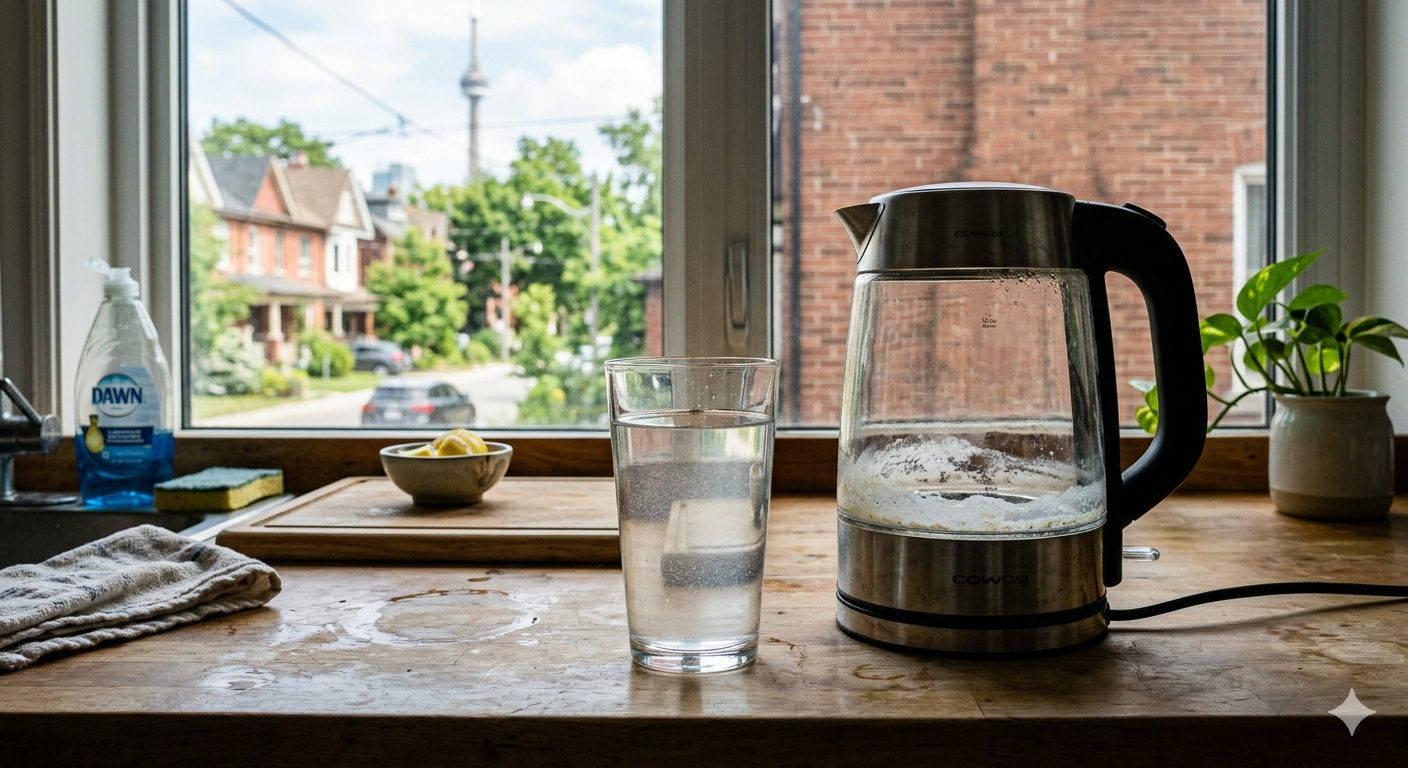
If you've ever noticed a white, chalky crust forming inside your electric kettle, or a visible residue coating the inside of your coffee maker's water reservoir — that's limescale, and it comes directly from Toronto's hard water minerals.
Limescale forms when hard water is heated: calcium and magnesium minerals precipitate out of the water and bond to the heating element and internal surfaces. Over time, this deposit accumulates into the familiar white crust that requires regular descaling to remove.
How Limescale Affects Your Kettle
Scale buildup on a kettle's heating element acts as insulation, forcing the element to work harder and longer to boil the same amount of water. Beyond the minor energy inefficiency, the more immediate effects that most people notice are changes in water taste — mineral particles that flake off into the water — and the need for frequent manual descaling every few weeks during heavy use.
How Limescale Affects Your Coffee
Coffee extraction is highly sensitive to water mineral content. Specialty coffee associations and baristas widely acknowledge that water hardness directly affects extraction quality: minerals in hard water bind to coffee compounds differently than soft water, which can make coffee taste flatter, more bitter, or less aromatic than it would with purer water.
Limescale buildup inside a coffee maker's internal tubing and brewing head also changes water temperature consistency and flow rate during extraction — both of which affect the cup. This is why regular coffee shops descale their machines on a schedule, and why home machines in hard-water cities like Toronto require more frequent maintenance.
💡 The Simple Test
Check the inside of your kettle right now. If you see a white ring or chalky coating — that's Toronto's hard water minerals in visible form. The same minerals are in every glass of water you drink straight from the tap, and in every cup of coffee or tea you make with unfiltered water.
What a Water Purifier Actually Solves
A quality water purification system installed at your kitchen tap treats the water you use for drinking, cooking, and filling your kettle — before any of those activities happen. It's worth being clear about what it genuinely improves.
What Changes with Purified Water
A water purifier using Reverse Osmosis (RO) technology removes the calcium and magnesium minerals responsible for hardness, along with chlorine, chloramines, and other dissolved contaminants. The result is water that tastes noticeably cleaner and lighter — more like the bottled water many people default to when they want better taste.
- ✅ Improved drinking water taste — mineral flatness and chlorine aftertaste are eliminated
- ✅ Better-tasting coffee and tea — water closer to the ideal mineral range for extraction produces a noticeably cleaner, more aromatic cup
- ✅ Cleaner-tasting cooking water — stocks, rice, pasta, and dishes that use unboiled water benefit from purer water
- ✅ No more kettle limescale — purified water contains almost no calcium or magnesium, so scale no longer forms on heating elements
- ✅ Less coffee maker maintenance — without hard water minerals entering the machine, descaling cycles become far less frequent
What a Water Purifier Does Not Change
A kitchen water purifier treats the water at your drinking and cooking tap. It does not affect shower water, laundry water, or water used elsewhere in the home. If your concerns extend beyond the kitchen — bathroom scale, appliance protection across the whole home — that requires a different type of system. A water purifier is specifically the right solution for drinking water quality, cooking water, and any kitchen appliance filled directly from a purified tap.
Want Cleaner, Better-Tasting Water in Your Toronto Kitchen?
Coway water purifiers use advanced filtration to remove hard water minerals, chlorine, and dissolved contaminants — giving you cleaner drinking water and better-tasting coffee and cooking water, straight from your kitchen tap.
Compare Water Purifiers for Toronto Homes →Free consultation • Professional installation • 📞 +1 416-873-4984 • 한국어 상담 가능
Frequently Asked Questions
Yes — Toronto's tap water is safe to drink. The calcium and magnesium that make water "hard" are essential minerals and pose no health risk when consumed. Toronto's water consistently meets all federal and provincial drinking water standards. The concern with hard water is primarily about taste and the experience of using it: the flat, faintly mineral quality many people notice, chlorine aftertaste, and the limescale it causes in kettles and coffee makers. Many Toronto residents choose to filter their drinking and cooking water for taste and peace of mind, rather than for safety reasons.
The white crust inside your kettle is limescale — calcium and magnesium deposits left behind when hard water is heated and evaporates. At Toronto's hardness level of 121 mg/L, limescale forms relatively quickly with regular use. Filling your kettle with water from a purified tap (rather than directly from the hard water tap) is the most effective way to prevent limescale from forming, because purified water contains almost no dissolved minerals.
Yes. Water mineral content has a significant effect on coffee extraction. Minerals in hard water interact with coffee compounds differently than purer water does — the result is often a flatter, less aromatic cup with slightly more bitterness. Coffee professionals typically recommend water in the 50–175 mg/L hardness range for best extraction. Toronto's water at 121 mg/L is on the higher end of that range, and many home brewers who switch to purified water notice a meaningful improvement in cup quality, especially for filter and pour-over styles where the water flavour is most apparent.
Yes — removing chlorine and chloramines is one of the core functions of a quality water purification system. Most systems use a combination of carbon filtration and (in RO systems) a semi-permeable membrane that removes dissolved gases and compounds, including chlorine. The result is water that lacks the faint bleach-like aftertaste that some Toronto tap water carries, particularly in older buildings where water spends more time in pipes.
Yes, for any cooking where you use water directly from your kitchen tap. Using purified water for rice, pasta, soups, stocks, and cold-water recipes results in cleaner flavour. The effect is most noticeable in dishes where water is a prominent ingredient or where the water is unboiled — for example, cold brew, ice cubes, or dishes like smoothies. For dishes with strong flavours that mask the water, the difference is minimal. But for tea, light broths, or plain boiled rice, the improvement is usually easy to detect.