
📋 Table of Contents
- 1. What Happened: Toronto's July 2026 Smoke Event
- 2. Why Wildfire Smoke Keeps Coming Back to Toronto
- 3. Why Wildfire Smoke Is Especially Harmful — Even Indoors
- 4. How Wildfire Smoke Gets Inside Your Home
- 5. How a HEPA Air Purifier Helps During Smoke Events
- 6. A Practical Checklist for Toronto Residents
- 7. Frequently Asked Questions
What Happened: Toronto's July 2026 Smoke Event
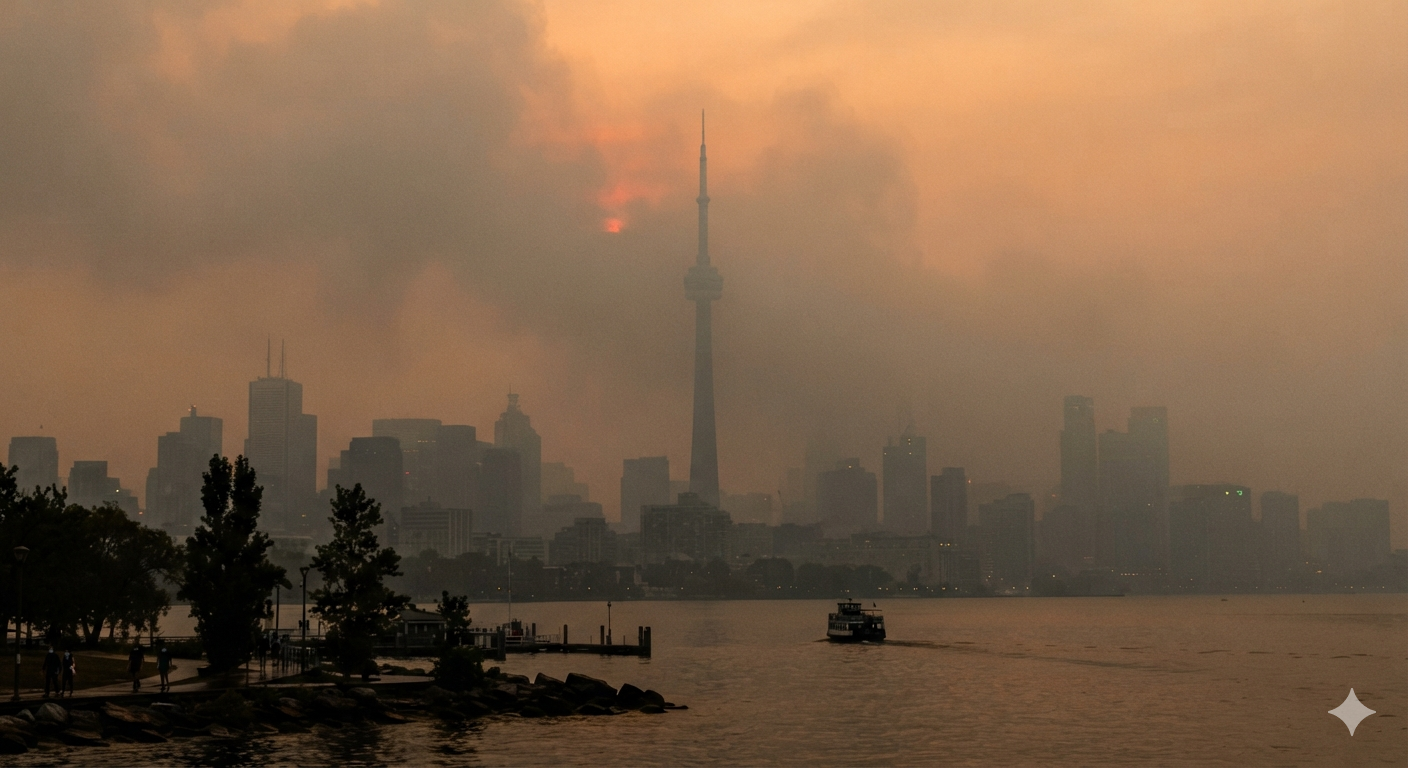
For three consecutive days beginning July 15, 2026, Toronto was blanketed in thick wildfire smoke drifting south from active fires in Northwestern Ontario. The CN Tower disappeared into a dense orange-grey haze. Environment Canada's Air Quality Health Index (AQHI) remained at 10+ — the highest possible rating, indicating "very high risk" — for much of the period.
At one point, global air quality tracker IQAir ranked Toronto as having the worst air quality of any city in the world, surpassing Kinshasa and New Delhi. The City of Toronto suspended lifeguard supervision at city beaches, closed outdoor pools, and cancelled strenuous outdoor programming. Residents across North York, Scarborough, Etobicoke, and downtown Toronto were advised to stay indoors.
⚠️ Environment Canada's July 2026 Advisory
During the smoke event, Environment Canada advised all Toronto residents to limit time outdoors, reschedule or cancel outdoor sports and activities, keep windows and doors closed as much as possible, and wear a well-fitting N95 or equivalent respirator if going outside was unavoidable. The advisory specifically noted that children, the elderly, pregnant individuals, and people with heart or lung conditions were at highest risk of health impacts.
Why Wildfire Smoke Keeps Coming Back to Toronto
The July 2026 event was not an isolated incident — and experts say Toronto residents should expect smoky summers to become more frequent, not less. This summer alone, more than 3,500 fires have burned over 6 million acres across Canada, with a dozen blazes flaring in Ontario in recent weeks.
Greg Evans, an engineering professor at the University of Toronto and director of the Southern Ontario Centre for Atmospheric Aerosol Research, told CTV News that summer wildfires are "becoming more normal" and that climate change is increasing both the frequency and intensity of Canadian wildfire seasons. Warmer springs are causing snow to melt earlier, drying vegetation sooner and extending the window in which fires can ignite and spread.
The 2023 season was Canada's worst wildfire season on record. The 2025 season brought smoke from Prairie fires drifting into southern Ontario as recently as July 31. The 2026 event brought conditions so severe that Toronto simultaneously experienced its worst smoke event while also under a heat warning — what one researcher called a "double whammy" that "really raised awareness of how prepared we are to deal with these types of incidents in the future."
💡 The AQHI Scale Explained
Canada's Air Quality Health Index (AQHI) runs from 1 to 10+. A reading of 1–3 is "Low Risk." Readings of 7–10 indicate "High Risk," at which point Environment Canada recommends the general public reduce or reschedule outdoor exertion. A reading of 10+ — the maximum — indicates "Very High Risk," at which point the recommendation is to avoid all outdoor physical activity and stay indoors as much as possible. Toronto reached 10+ and sustained it for multiple days in July 2026.
Why Wildfire Smoke Is Especially Harmful — Even Indoors
Wildfire smoke is not simply unpleasant-smelling air. It is a complex mixture of fine particles, gases, and chemical compounds produced by the combustion of organic material — trees, soil, vegetation — over vast areas. The primary health concern is PM2.5: fine particulate matter with a diameter of 2.5 micrometres or less.
PM2.5 particles are small enough to penetrate deep into the lungs and, in sufficient concentrations, enter the bloodstream. Unlike larger particles that are filtered by the nose and throat, PM2.5 bypasses those natural defences. Short-term exposure can cause eye, nose and throat irritation, coughing, headaches, and worsened asthma. During severe events like the July 2026 Toronto smoke episode, Environment Canada also noted that chest pain, wheezing, and severe cough were possible at sustained AQHI 10+ levels.
Groups at highest risk include children (whose respiratory systems are still developing), elderly residents, people with asthma, COPD, or heart disease, and pregnant individuals. But even healthy adults experience measurable lung function reduction during multi-day smoke events at the concentrations seen in Toronto in mid-July 2026.
⚠️ "Indoors" Does Not Mean Safe by Default
During a smoke event, staying inside significantly reduces exposure compared to being outdoors — but it does not eliminate it. PM2.5 particles are small enough to infiltrate through gaps in window frames, door seals, and HVAC systems. In older Toronto homes and condos with less effective sealing, indoor PM2.5 levels can reach 50–80% of outdoor levels during severe smoke events. Running a HEPA air purifier with windows closed is the most practical step to further reduce indoor particle concentrations.
How Wildfire Smoke Gets Inside Your Home
Many Toronto residents assume that closing windows is sufficient protection during a smoke event. Closing windows is important — and is directly advised by Environment Canada — but it is not a complete solution on its own. Here's why.
PM2.5 particles at 2.5 micrometres are extremely fine. They infiltrate homes through the same pathways that air naturally moves: gaps around window frames, under doors, through exhaust fans, through forced-air HVAC systems that draw in outdoor air, and even through the structural porosity of the building envelope itself. In newer, tightly sealed condos and homes the infiltration rate is lower; in older Toronto houses — common in the Annex, Leslieville, Scarborough, and North York — natural air infiltration rates are significantly higher.
Additionally, if you or anyone in your household goes outdoors during a smoke event and returns home, smoke particles will have settled on clothing, hair, and skin and will be carried inside. Opening the door even briefly to enter or leave allows a burst of smoke-laden outdoor air indoors.
💡 Indoor vs. Outdoor PM2.5 During Smoke Events
Research on indoor/outdoor PM2.5 ratios during wildfire smoke events consistently shows that indoor particle levels in homes without filtration typically reach 50–80% of outdoor concentrations within a few hours of a smoke event beginning, even with windows closed. Running a HEPA air purifier actively works against this infiltration by continuously removing particles from the indoor air faster than they can enter.
How a HEPA Air Purifier Helps During Smoke Events
A HEPA (High Efficiency Particulate Air) filter is certified to capture at least 99.97% of airborne particles 0.3 microns and larger. PM2.5 wildfire smoke particles, at 2.5 microns, are well within the range that True HEPA filters capture effectively. Running a HEPA air purifier in the rooms where you spend the most time — particularly the bedroom — during a smoke event actively reduces the concentration of PM2.5 particles in that space.
The key word is "continuously." An air purifier reduces indoor particle concentrations while it is running by cleaning the air that passes through it. The higher the air exchange rate relative to the room size (reflected in the CADR — Clean Air Delivery Rate), the more effectively it can reduce PM2.5 concentration even as new particles continue to infiltrate from outside.
What a HEPA Air Purifier Can Do During a Smoke Event
- ✅ Remove PM2.5 fine particles from indoor air — the primary health hazard from wildfire smoke
- ✅ Reduce indoor smoke odour — activated carbon pre-filters adsorb gaseous smoke compounds that HEPA alone does not capture
- ✅ Lower overall indoor allergen and particle load — especially valuable for asthma and allergy sufferers who are most vulnerable during smoke events
- ✅ Create a cleaner "refuge room" — running a purifier in the bedroom allows for safer overnight rest when smoke persists for multiple days
What a HEPA Air Purifier Cannot Do
- ❌ It cannot stop smoke from entering the home — it treats air already inside, not air at the point of entry
- ❌ It cannot fully replace an N95 mask outdoors — if going outside is necessary during high AQHI conditions, wear a properly fitted N95
- ❌ It cannot protect rooms where it is not running — coverage is limited to the area matched to the unit's CADR rating
- ❌ It cannot eliminate gaseous pollutants from smoke without a carbon layer — HEPA alone does not capture carbon monoxide or other smoke gases; a combined HEPA + activated carbon system addresses both
Choosing the Right Coverage for Your Space
The CADR (Clean Air Delivery Rate) rating tells you how quickly a purifier cleans air in a given room size. During a smoke event, air quality organizations recommend running a purifier rated for a room 1.5 to 2 times larger than the actual room, to achieve a higher air change rate against the elevated incoming particle load. A unit rated for a 300 sq. ft. room will be more effective in a 200 sq. ft. bedroom during severe smoke conditions than it would be during a normal air quality day.
💡 Which Room to Prioritize
If you have one air purifier, place it in the bedroom. During multi-day smoke events like Toronto's July 2026 episode, you will spend 7–8 hours overnight breathing the same room's air. Keeping that space's PM2.5 concentration as low as possible has the most impact on total daily exposure. If you have a second unit, the main living area where you spend daytime hours is the next priority.
A Practical Checklist for Toronto Residents During Smoke Events
When Environment Canada issues a Special Air Quality Statement or the AQHI reaches 7 or above, follow these steps:
- 🔴 Keep windows and doors closed — even in summer heat; use air conditioning if available, and set it to recirculate indoor air rather than draw in outdoor air
- 🔴 Run your HEPA air purifier — set it to its highest effective setting in the bedroom and main living area; do not turn it off overnight
- 🔴 Check AQHI before going outside — use the IQAir app, the Weather Network, or Environment Canada's AQHI website for real-time Toronto readings
- 🔴 If you must go outside, wear an N95 — cloth masks and surgical masks do not filter PM2.5 effectively; only a well-fitted N95 or equivalent respirator provides meaningful protection outdoors
- 🔴 Shower and change clothes when returning indoors — smoke particles settle on hair, skin, and fabric and will otherwise be distributed inside your home
- 🔴 Avoid adding to indoor air pollution — do not burn candles, use gas stoves for prolonged periods, or smoke indoors during a wildfire smoke event; these add to the PM2.5 load your lungs are already managing
- 🟡 Check on vulnerable neighbours — children, elderly residents, and those with asthma or heart conditions are most at risk and may not have access to air purification
- 🟡 Replace your purifier's filter if it has been overworked — multi-day smoke events at AQHI 10+ load HEPA filters significantly faster than normal conditions; check filter indicators after a sustained smoke episode
Protect Your Family's Indoor Air This Summer
Coway air purifiers use True HEPA filtration with activated carbon to reduce PM2.5 wildfire smoke particles and smoke odour indoors — giving your family a cleaner, safer environment when Toronto's outdoor air is at its worst.
Find the Right Coway Air Purifier for Your Home →Free consultation • Professional setup support • 📞 +1 416-873-4984 • 한국어 상담 가능
Frequently Asked Questions
Closing windows is an important first step and significantly reduces smoke infiltration — Environment Canada specifically advises this during air quality events. However, it is not complete protection on its own. PM2.5 particles are small enough to infiltrate through gaps in window frames, under doors, and through building ventilation. In older Toronto homes, indoor PM2.5 levels can still reach 50–80% of outdoor levels within hours of a smoke event even with windows closed. Running a HEPA air purifier indoors actively works against this infiltration by continuously removing particles already in the air.
Air conditioning helps by keeping windows closed and maintaining comfort indoors, which reduces the urge to open windows during smoke events. However, a standard AC unit does not filter PM2.5 particles — it circulates and cools air but does not remove fine particulates. If your AC draws in fresh outdoor air rather than recirculating indoor air, it can actually increase indoor smoke particle levels during a severe event. Check your AC settings and switch to recirculation mode if available. A HEPA air purifier is the appropriate tool for actively removing PM2.5 from indoor air.
Check the AQHI for Toronto on Environment Canada's website, the IQAir app, or the Weather Network. When the AQHI is 4–6 (moderate risk), your purifier's standard or auto setting is appropriate. When the AQHI reaches 7–10 (high risk), run the purifier at a higher setting and keep it running overnight. When the AQHI is 10+ (very high risk, as it was in Toronto on July 15–17, 2026), run the purifier continuously at its highest effective setting in your sleeping area and main living space, and keep windows closed at all times.
Experts say smoky summers are becoming more frequent in Toronto, though no single summer is guaranteed to repeat the same conditions. University of Toronto engineering professor Greg Evans told CTV News in July 2026 that wildfire smoke is "becoming more normal" for Canadians. Warmer, drier conditions — linked to climate change — extend the wildfire season and increase the likelihood of large fires in Northern Ontario that send smoke south to the GTA. The 2023, 2025, and 2026 seasons all brought significant smoke events to Toronto. Planning for recurring summer smoke episodes — including having a working HEPA air purifier at home — is the practical response.
Multi-day smoke events at AQHI 10+ load HEPA filters far faster than normal operating conditions. If your air purifier ran continuously for 3 or more days during a severe smoke event, check the filter life indicator after conditions improve. A significantly loaded filter loses efficiency and may no longer capture PM2.5 at the certified rate. If your unit does not have a filter life indicator, inspect the filter visually — heavy grey-brown discolouration from smoke particles is an indicator that replacement is due sooner than the regular schedule.